

Table of Contents
- Why Your Skincare Routine for Aging Skin Needs a Reset in 2026
- Gentle Skincare Ingredients for Mature Skin That Do the Real Work
- Simple Morning and Evening Skincare Steps You Can Keep
- How to Build a Sustainable Self-Care Ritual Around Your Routine
- The Non-Skincare Factors That Shape How Your Skin Ages
- Budget-Friendly Skin Minimalism: Fewer Products, Better Skin
- Common Mistakes That Quietly Undo a Good Skincare Routine
- Conclusion: Loving the Woman You're Becoming
- Frequently Asked Questions
Last Updated: October 3, 2026
Why Your Skincare Routine for Aging Skin Needs a Reset in 2026
If your regimen was built five years ago, it was designed for a different version of your skin. A skincare routine for aging skin in 2026 looks simpler, gentler, and far more strategic than the ten-step routines we were sold a decade ago.
The industry is shifting away from aggressive anti-aging language toward something called skin longevity, a reframe that matters more than any single product.
Skin Longevity, Not Anti-Aging: A Kinder Way to Think About It
When the goal is "anti-aging," every mirror check becomes a test you can fail. When the goal is longevity, consistency beats intensity, and your skin barrier becomes the priority.
Barrier health drives everything downstream: hydration, texture, how well your actives perform. A compromised barrier makes fine lines look deeper and skin duller, no matter how many serums you layer on top.
Gentle Skincare Ingredients for Mature Skin That Do the Real Work
You don't need fifteen products, you need the right four or five. Gentle skincare ingredients for mature skin fall into two groups: those that support your barrier and those that stimulate renewal. Get the first group right before you touch the second.
Barrier Support First: Ceramides, Peptides, and Hyaluronic Acid
Ceramides are lipids that hold your skin's protective layer together. Peptides support the look of firmness and elasticity. Hyaluronic acid draws water into the skin, which mature skin typically holds less of.
If your skin feels tight, reactive, or easily irritated, that's your signal to pause actives and rebuild. Our LUV BEAUTY™ Hyaluronic Acid Serum uses four types of hyaluronic acid to support multi-level hydration, which makes it a natural starting point for a routine that's been feeling dry or depleted.

Actives That Still Earn Their Place: Retinoids and Vitamin C
Retinoids remain the most studied ingredient for supporting cell turnover and smoother-looking texture. Vitamin C brings antioxidant support against daily environmental exposure. Both still matter for mature skin; the difference is how you introduce them.
Start with two or three nights a week for a retinoid, buffered over moisturizer if your skin is sensitive. Vitamin C belongs in the morning, before sun protection.
Simple Morning and Evening Skincare Steps You Can Keep
A sustainable routine has four steps in the morning and four at night. Simple morning and evening skincare steps work because you'll actually do them on a tired Tuesday, and because they flex as your skin changes.
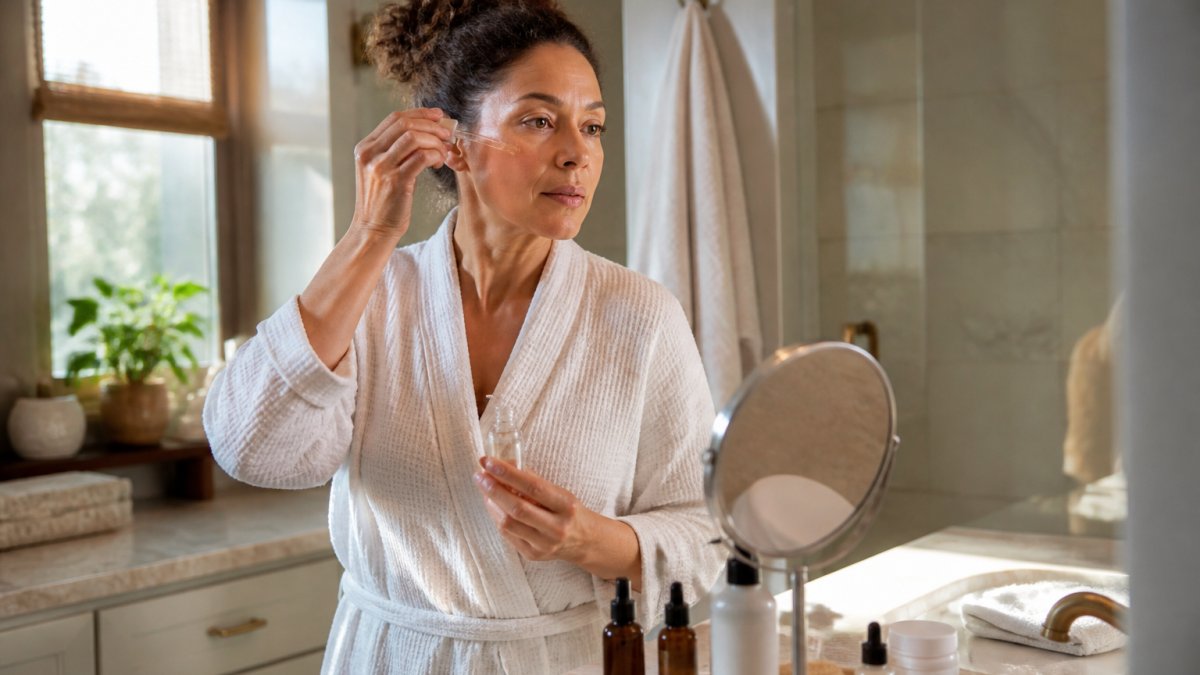
Your Morning Routine: Protect and Hydrate
- Gentle cleanse. A fragrance-free cream or gel cleanser. If your skin feels tight afterward, it's too harsh.
- Antioxidant serum. Vitamin C, if your skin tolerates it.
- Moisturize. This is where ceramides and peptides go to work.
- Sun protection. Broad-spectrum SPF 30 or higher, every single day.
Sun protection is the single most effective thing you can do for how your skin ages. UV exposure breaks down collagen and elastin over time, which is why dermatologists place sunscreen above every serum on the shelf.
Your Evening Routine: Repair and Restore
- Remove sunscreen and makeup. This step is non-negotiable.
- Cleanse. Same gentle cleanser as the morning.
- Treat. Retinoid two or three nights a week; hydrating serum on the others.
- Moisturize. A richer cream at night supports overnight repair.
Our LUV BEAUTY™ Anti-Aging Moisturizer is built for mature skin, supporting hydration and the look of elasticity while softening the appearance of fine lines and dryness. Used at night, it seals in everything underneath it.
| Time of Day | Step | Product Type | Frequency |
|---|---|---|---|
| Morning | Cleanse | Gentle, fragrance-free cleanser | Daily |
| Morning | Treat | Vitamin C serum | Daily |
| Morning | Moisturize | Ceramide or peptide cream | Daily |
| Morning | Protect | Broad-spectrum SPF 30+ | Daily |
| Evening | Cleanse | Same gentle cleanser | Daily |
| Evening | Treat | Retinoid or hydrating serum | Alternate nights |
| Evening | Moisturize | Richer night cream | Daily |
How the Routine Shifts in Your 40s vs. Your 50s
Skin in your 40s and 50s is not the same terrain. Adjust the dials rather than rebuild the whole shelf.
In your 40s, combination skin often turns drier in places and still oily in others, with the first texture changes around the eyes and jawline.
In your 50s, declining estrogen is linked to reduced oil production, thinner skin, and slower cell turnover.
Hormonal Changes and Your Skin: What's Actually Happening
Hormones are the quiet variable most skincare guides skip. Estrogen supports collagen production, skin thickness, and moisture retention; when it declines, skin often feels drier, looks less plump, and heals more slowly.
What helps: lean into barrier support, don't increase exfoliation when skin feels dull (that's usually a hydration problem, not buildup), and ask a dermatologist whether prescription options like topical estrogen or tretinoin are appropriate for you.
When to Introduce Actives (and When to Pause)
A simple rule: introduce one new active at a time, and give it four to six weeks before adding anything else.
Layering order matters too. Thinnest to thickest: cleanser, toner (if you use one), water-based serum, treatment serum, moisturizer, sunscreen in the morning.
Our LUV SKIN™ Retinol + Peptide Face Serum pairs retinol with peptides and soothing botanicals, which is exactly the kind of pairing that makes an active easier to live with long term.

How to Build a Sustainable Self-Care Ritual Around Your Routine
Learning how to build a sustainable self-care ritual is less about discipline and more about design.
Anchor it to something you already do. Skincare happens after you brush your teeth, not at some ideal hour that never arrives.
The mental shift matters too. This is not a chore list; it's ten minutes that belong to you.
The Non-Skincare Factors That Shape How Your Skin Ages
Your skin doesn't know it's on a separate schedule from the rest of your life. Sleep, stress, hydration, nutrition, and movement all show up on your face, and no serum compensates for a body running on empty.
Sleep: The Overnight Repair Window
Overnight is when skin repair activity peaks. Growth hormone rises during deep sleep, and that's when collagen synthesis and cellular turnover do much of their work.
A practical move: treat your evening skincare as the start of your wind-down, not the end of your day. Dim the lights, put the phone down, and let the ritual itself signal to your body that rest is coming.
Stress: The Cortisol Connection
Chronic stress raises cortisol, and elevated cortisol is linked to increased inflammation, slower barrier recovery, and, over time, breakdown of collagen and elastin.
You can't delete stress, but you can blunt its skin impact. Ten minutes of walking, a few minutes of breathwork, or simply protecting one quiet hour a day all count. The goal isn't a perfect life; it's a nervous system that isn't stuck in overdrive.
Hydration and Nutrition: What Actually Reaches Your Skin
Drinking water supports overall health, though the direct line from glass to glow is more modest than marketing suggests. What matters more is enough healthy fats, omega-3s from fish, walnuts, and flaxseed support the skin's lipid barrier, and enough protein, since collagen and elastin are built from amino acids.
A simple frame: build meals around protein, healthy fat, and something colorful. That's not a diet; it's the raw material your skin uses to repair itself.
Movement: Circulation and Lymphatic Flow
Regular movement supports circulation, which delivers oxygen and nutrients to skin and helps carry waste away. It also supports lymphatic flow, which is part of why a walk or a workout can leave your face looking brighter.
This is where we think about wellness as a whole rather than a category. Our LUV LIFE™ NMN Capsules deliver 500 mg of ß-Nicotinamide Mononucleotide per serving, a precursor to NAD+, a coenzyme involved in cellular energy production.

These statements have not been evaluated by the Food and Drug Administration. This product is not intended to diagnose, treat, cure, or prevent any disease.
Budget-Friendly Skin Minimalism: Fewer Products, Better Skin
Skin minimalism is the practice of using the fewest products that fully support your skin, and it happens to be the cheapest approach available.
The spending trap is novelty. A new serum promises a new result, so we buy it, use it twice, and add it to the pile.
A realistic minimal routine is five products: cleanser, moisturizer, sunscreen, one serum for hydration, and one active.
Common Mistakes That Quietly Undo a Good Skincare Routine
Most routines don't fail dramatically. They fail slowly, through small habits that cancel out the good ones.
- Over-exfoliating. Chemical exfoliation with glycolic acid, lactic acid, or salicylic acid more than once or twice a week strips the barrier. More is not better here.
- Skipping sunscreen on cloudy days. UV exposure doesn't take the day off, and this is the single biggest driver of visible aging.
- Layering too many actives at once. Retinoids, acids, and vitamin C in the same sitting is a recipe for irritation.
Conclusion: Loving the Woman You're Becoming
There's a quiet psychological weight to watching your skin change, and it deserves to be named rather than smoothed over. The women we talk to don't want to look twenty-five again.
That's the whole idea behind our LUV SKIN™ collection: skincare as a moment of choosing yourself, not a correction of what's wrong. Gentle cleansing, real hydration, steady sun protection, and a few ingredients that earn their place.
You are not broken. You are becoming, BeLovelyfied.
Frequently Asked Questions
What is the most effective skincare routine for aging skin?
The most effective approach pairs gentle cleansing with barrier-supporting hydration and one or two proven actives. Think: a fragrance-free cleanser, a hydrating serum with hyaluronic acid, a moisturizer with peptides, and daily sun protection. In the evening, add a retinoid a few nights a week and build up slowly. Consistency over months matters far more than the number of products you layer on.
What are the most effective, gentle ingredients for mature skin in 2026?
Look for peptides, hyaluronic acid, ceramides, niacinamide, and antioxidants like vitamin C. These support hydration, skin elasticity, and the skin barrier without the sting that stronger acids can cause. For exfoliation, lactic acid is often gentler than glycolic acid. Retinoids still hold their place, but start with a low-strength formula two nights a week and buffer with moisturizer if your skin feels tight.
What is the difference between 'anti-aging' and 'pro-aging' skincare philosophies?
Anti-aging marketing often implies you need to fight or reverse something. A pro-aging or skin longevity approach focuses on caring for the skin you have now: supporting collagen production, barrier health, and hydration so skin looks and feels its best over time. Many women find the second mindset easier to stick with because it removes the pressure and the guilt.
How can I simplify my daily skincare ritual for better consistency?
Cut your routine down to what you will actually do on a tired Tuesday night. A three-step evening routine (cleanse, treat, moisturize) beats a ten-step one you skip. Keep morning to cleanse, hydrate, and protect. Store the products you use daily within reach and move the rest to a drawer. Fewer decisions mean fewer missed nights, and consistency is what shows up in your skin.
What role does lifestyle play in skin health for women over 40?
Sleep, stress, hydration, and sun exposure all influence how skin looks and feels. Poor sleep and chronic stress can show up as dullness and increased sensitivity. Daily sun protection is one of the most impactful habits for skin longevity. Nutrition and movement support overall wellness, which in turn supports your skin. Skincare works best as part of a broader self-care picture, not in isolation.
Do I need a separate morning and evening skincare routine?
Yes, but the difference can be small. Mornings focus on hydration and protection: cleanse, hydrate, moisturize, and apply sunscreen. Evenings focus on repair: cleanse thoroughly to remove sunscreen and makeup, then apply your treatment serum and a richer moisturizer. Retinoids and exfoliating acids belong in the evening because sun exposure can make skin more sensitive to them.